A response to Nicolas Kistof August 6 op-ed article in the NYT (unfortunately it wasn't published):
_________________________________________________________________
I live and work as a humanitarian aid worker in West Darfur. Nicolas Kristof’s “Plan for the Future for Darfur” was disturbing, and indeed some of his proposed solutions demonstrated a misunderstanding of the current humanitarian crisis.
The article refers to supposed ongoing mass “slaughter” (a sensationalistic word that was used four times), a military campaign against innocent civilians, and a pro-active government bent on the killing of black Africans.

But Kristof is reading from an outdated script. From my perspective – I visit IDP camps on a weekly basis, I read up-to-date security briefings daily from NGOs and UN personnel traveling throughout Darfur, and I work every day among Darfuris – what is happening now cannot be described as genocide.
It most probably was, though, back in 2003 and in the beginning of the rebellion, when the government armed the janjaweed and gave them free reign over a territory the size of France. Then, the government moved ahead of armed and mounted men, bombed any village that was suspected of supporting the new rebellion, and turned their backs as the (Arab) janjaweed moved in and killed or raped those who were left standing.
But it is a different crisis now. Most of the violence this year has been opportunistic banditry, against both villages and humanitarian actors. This is a natural corollary to the large amounts of arms now locally available, as well as the massive injection of humanitarian money that has occurred since this crisis began. Arab tribes are fighting other Arab tribes, armed groups are carjacking and robbing convoys of NGOs which they now identify as an easy source of cash, villages are being attacked by small groups of armed men, but large scale attacks like happened before have not occurred in a long time.

The fighting between the rebels and the government is now on the sidelines. New forces have developed from the old. The janjaweed have - like the rebels - broken up into different factions and may be acting beyond Khartoum’s control. Chadian rebels have infested Western Darfur and stage attacks against the government of Idriss Deby from the almost totally porous border, as the Sudanese opposition is doing from the opposite side.
Kristof’s first solution to bringing peace in Darfur – by supporting the peace negotiations that were recently completed in Arusha – will achieve little and indeed most people here on the ground have little faith in the discussions. Those representing the rebels in Arusha are viewed as puppets of the government and whose participation in the peace talks is meant to discredit the real representatives of the rebellion. Without Abdul Wahid, the leader of the SLM faction that is most popular and who is not represented at the talks, there will be little real coherence if any accord is achieved and it will therefore be a simple replay of Abuja.

Using satellites to monitor Darfur, as he recommends, in order to “reduce the chance that Sudan will slaughter” 130,000 residents of a certain “beleaguered” IDP camp is unnecessary and not feasible. There are tens of thousands of humanitarian workers throughout Darfur, and many of them are acting as a witness that could get through to the world on satellite phones and internet connections (yes, Darfur has DSL) if such an unlikely catastrophe occurred. The government already knows they are being watched.
There is also a technical problem that the UN faced when they came up that same idea years ago: from a satellite perspective, a recently destroyed village and one that was abandoned 20 years ago for unrelated reasons look the same. Just look on Google maps and you will see.
Using reductive and morally comfortable good guy/bad guy scenarios and then constructing military or political solutions from them will lead us into a similar situation as that in Iraq. And bringing a Darfuri refugee to the white house lawn for a photo-op, as Kristoff suggested, will only reinforce the image that Africa is full of evil aggressors and victims that should be “rescued” by the West.
Since January 2007, according to many estimates, there have been less than a dozen people killed by offensive Sudanese military flights. What good then will be an enforcement of a no-fly zone over Darfur, as Kristof and others such like Hillary Clinton recommend?
Lastly, there is a likelihood that the war with the South will begin anew, as the government in Khartoum has shown little progress in implementing the Comprehensive Peace Agreement, which ended the 22-year long civil war in 2005. But does Kristof honestly think that arming the South is part of the solution, when Sudan has only had a decade of peace since World War II and so recently ended a war that killed millions of its people? The answer must lie elsewhere.

I don’t pretend to know what would bring peace to this region. But there are some solutions that might be more likely to lead us towards peace. They are all more complicated than the simple list of suggestions that are supplied by Kristof, and none of them are likely be followed under the current regime in Khartoum, no matter how much international pressure is put on it.
Nomadic corridors must once again be reopened to allow the movement of cattle and Arab tribes to and from their traditional grazing grounds. There are approximately 12 million head of cattle in Darfur – that is more than twice the population of humans – and the cattle trade has been an important aspect of both the local and national economy. Without the migration nothing will return to normal, and neither nomads nor farmers will be able to rebuild their livelihoods.
All non-state armed groups must be convinced to disarm. This might be accomplished with the presence of the 26,000 UN peacekeepers that are set to arrive in October, though it is not guaranteed.
IDPs and refugees, once the security situation is improved, must be given a real incentive to return to their villages. Maternal health, infant mortality, access to potable water and free health care have all been dramatically improved through the intervention of humanitarian actors. But few journalists are brave enough to note that this improvement is from pre-conflict conditions, and in many areas the level of life of displaced people has been dramatically increased as a result of being in the camp itself. Conditions here are much better than they are in South Sudan, or in some other regions of Africa. Although I am not disregarding the horror that many displaced people have lived through, in the long-term, this means that few will want to return to their villages where none of these services are available. Who will make such an enormous investment?
What will bring ultimate peace to this area is not a cease fire or the presence of UN troops, but electricity, roads, education and enough investment to make those in Darfur feel that they are Sudanese. That, after all, is what started this crisis. It is the only thing the divided rebel movements unanimously agree on.
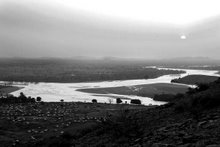
 Driving through this town, I often stumble upon refreshing scenes: a Wadi full of ebullient children playing soccer and volleyball, a truck of armed and savage-looking Chadian rebels whose intimidation melts away with my wave of greeting, a man sitting in the peace of a mango tree’s shade reading a Koran, a busy street market rushing through the day’s last sales in order to avoid the oncoming downpour that threatens in gusts from a darkened horizon. I have started bringing my camera wherever I go in the hopes of capturing another side of Darfur that has gone without mention in most of the popular media. Darfur is a very beautiful place, full of very kind people, and I wish writers would add some variety to their analysis of this world and stop advertising it as a place of only "hunger, violence, slaughter," and "chaos." Those words appear in almost every article I read of Sudan.